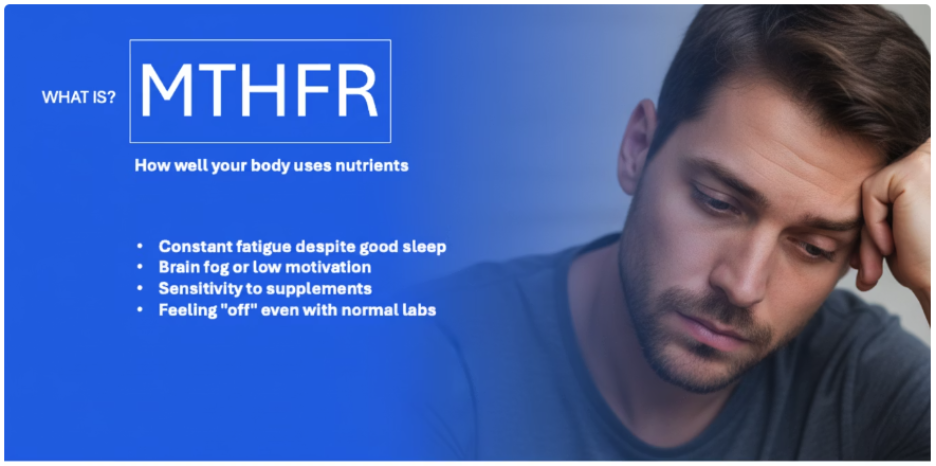
If you’ve ever heard the term MTHFR and immediately felt confused, overwhelmed, or slightly alarmed — you’re not alone.
For some people, it’s been framed as a “big problem.”
For others, it’s dismissed as irrelevant.
The truth sits quietly in the middle.
MTHFR matters — but not in the way it’s often presented.
This article exists to explain, clearly and calmly:
- What methylation actually is
- How MTHFR fits into the picture
- Why energy, focus, and mood are often involved
- And how to think about this without panic or hype
First: What Methylation Actually Is
Methylation is a basic biochemical process that happens billions of times per day in your body.
It plays a role in:
- Energy production
- Neurotransmitter balance
- Detoxification
- Inflammation regulation
- DNA repair
Think of methylation as a cellular efficiency system.
When it’s working smoothly, things feel steady.
When it’s inefficient, energy often feels inconsistent.
Where MTHFR Comes In
MTHFR is a gene involved in one step of the methylation process.
Some people have genetic variations that make this step less efficient.
Important clarification:
- This does not mean something is “broken”
- It does not mean you’re destined for poor health
- It does not automatically require treatment
It simply means your body may process certain nutrients differently.
Why Energy Is Often the First Thing People Notice
When methylation efficiency is reduced, the body may struggle with:
- Converting nutrients into usable energy
- Supporting neurotransmitters linked to motivation and focus
- Clearing metabolic byproducts efficiently
The result isn’t dramatic failure — it’s often low-grade friction.
That friction shows up as:
- Persistent fatigue
- Brain fog
- Inconsistent response to supplements
- Feeling “off” despite doing the right things
This is why methylation conversations often overlap with energy concerns.
Why Blood Tests Don’t Always Show the Issue
Standard labs can look completely normal.
That’s because:
- Labs measure levels, not pathway efficiency
- Methylation issues are often functional, not deficient
- The body compensates quietly — until it can’t
This is why so many people resonate with “normal labs, low energy” experiences.
(We break that down further in Normal Labs, Low Energy: 8 Things Blood Tests Often Miss.)
The Supplement Confusion Around MTHFR
This is where things often go wrong.
People hear “MTHFR” and immediately:
- Add multiple supplements
- Change everything at once
- Assume more is better
But methylation is sensitive.
Too much support can feel just as bad as too little.
This is why some people:
- Feel anxious after certain B vitamins
- Feel wired but tired
- Feel worse instead of better
Context matters.
Why “Just Take Methylated B Vitamins” Isn’t Good Advice
You’ve probably heard this recommendation.
Sometimes it helps.
Sometimes it backfires.
Why?
Because methylation doesn’t exist in isolation.
It interacts with:
- Stress response
- Gut absorption
- Detox pathways
- Overall nutrient balance
Supporting one part of the system without understanding the rest can create imbalance.
This is where clarity beats urgency.
How to Think About MTHFR the Right Way
Here’s the healthiest mental model:
MTHFR is one lens, not the whole picture.
It helps explain:
- Why certain supplements never worked
- Why timing matters
- Why subtle changes can have outsized effects
It does not dictate your future.
It informs your decisions.
Why Genetics Add Context Without Fear
Genetic insights aren’t diagnoses.
They’re explanations.
They help answer questions like:
- Why do I respond differently than others?
- Why did this protocol help before but not now?
- Why does my energy fluctuate so easily?
When viewed calmly, genetics reduce anxiety — they don’t create it.
The Real Goal: Efficient, Sustainable Energy
The goal isn’t to “fix methylation.”
The goal is to:
- Support energy production efficiently
- Reduce unnecessary strain
- Create consistency instead of spikes
For some people, that involves targeted nutritional support.
For others, it’s about removing what isn’t helping.
The key is knowing which is which.
Where to Start (Without Overdoing It)
If methylation has come up for you and you’re unsure what to do next, start with understanding — not action.
Tools like the Energy Unlocked Supplement Blueprint help place methylation in context:
- How it relates to your energy pathways
- Whether it’s likely contributing to symptoms
- How to approach support gradually and thoughtfully
No panic.
No overhauls.
Just clarity.
👉 Get the Energy Unlocked Supplement Blueprint
How This Fits With Everything Else You’ve Read Here
MTHFR connects directly to:
- Why supplements don’t work universally
- Why labs miss important context
- Why energy feels fragile for some people
- Why expert advice conflicts
If you haven’t yet, these articles tie together:
They’re all chapters of the same story.
Final Thought
MTHFR isn’t something to fear.
It’s something to understand.
And when you understand it — in context — it often explains a lot of what never made sense before.